Drovers
Drovers used to refer specifically to humanoid denizens of the Farsea swamps and in time has come to refer to all those employed gainfully in the pursuit of the swamp lands resources.
Historically, human life was separate of the swamp peoples, humanoids unable to co-exist with Bullywugs, lizardfolk, the various fish peoples or the range of gnolls and other forms of beastpeoples who make up the populous.
Since the time of troubles and although at times tenuous, there are more and more of each making a home closer to each other.
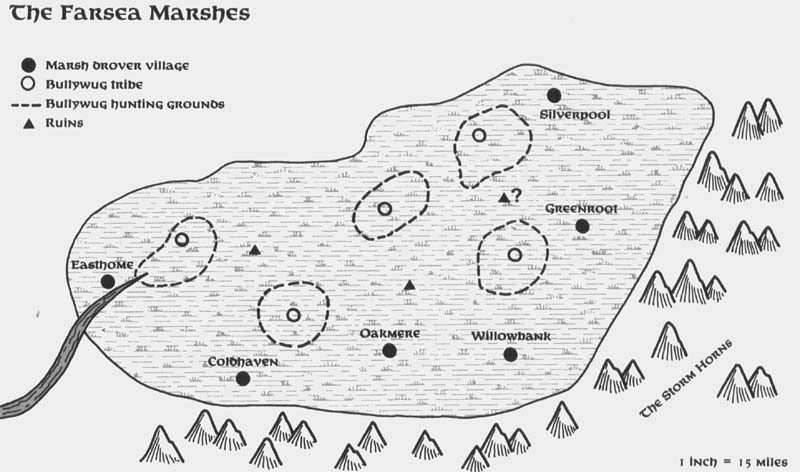 This map is circa ~1200 DR but the settlements still exist, hidden in the dark marshes of the Tuns.
Drovers are known for being experts in harvesting the swamps resources. Nearly tribal in their way of life, passing their routines and secrets through their lineage, the Drover life is a simple farming life for the many who inhabit these pockets of civility amid the ravenous and chaotic swamplands.
To native swamp races, Drovers represent a true friend in humanity thus manh of the settlements brand, tattoo or carve a crest to identify themselves in their lineage for pride and safety.
Drovers speak fluent swamp tongues and swamp speech although typically only a shaman, elder or chief of a settlement can scribble (swamp scribble).
Drover settlements:
You can read more about Drovers on the Forgotten Realms Wiki here.
The Tunlar Drovers
Within the broader Drover identity, one significant sub-group has developed its own distinct cultural identity: the Tunlar Drovers, who inhabit the Tuns — the lower-lying, older marshlands that pre-date the Farseas Swamps as a political entity. The Tunlar take their name from the Tun Marshes and are distinguished by their deeper integration with the marsh's original beast-peoples, their older lineage in the region, and certain unique cultural traditions and dialects that set them apart from Drovers of the higher Farseas swamps.
The Tunlar are considered the "old blood" of the Drover peoples — the families that were here before the Hiren Kropus era, before the methane economy, before the great cities. They look at the industrialization of the swamp with the specific wariness of those who remember what it looked like before.
Swamp Creole: The Common Tongue of the Farseas
The centuries of co-existence between Drovers and the beast-peoples of the swamp have produced something remarkable: a genuine creole language, sometimes called Swamp Creole or informally Swamp Tongue, that serves as the common lingua franca among all denizens of the Farseas — frog peoples, lizard peoples, fish peoples, and humanoid Drovers alike.
This creole blends phonemes and vocabulary from all the swamp races, with the Common tongue of Cormyr serving a function roughly analogous to a formal register — used for legal documents and dealings with outsiders, while the creole handles everyday communication.
Phonetic Signatures:
- Frog peoples: g, gr, ow, ob, gh, ug, ul, wa, wo, oot
- Lizard peoples: a, z, sh, xi, sho, sy, Sul, sla, sz, esh
- Fish peoples: wob, bow, ouya, glub, bub, yop, yup, smoo, map, mop
Sample vocabulary:
| Meaning | Frog | Lizard | Fish |
|---|---|---|---|
| Hello | Grugow | Zhasy | Wobglub |
| Goodbye | Ootwag | Sla'esh | Yupbub |
| Water | Uglum | Sulxa | Glub |
| Food | Grob | Sho'sik | Mopyop |
| Friend | Waggh | Sula | Yopbow |
| To go | Groot | Sla'zesh | Wobbow |
Drovers who have lived generations in the swamps speak the creole natively, often more fluently than formal Common. Only their shamans, elders, and chiefs typically master Swamp Scribble — the written form — which combines elements from all the contributing languages into a unique pictographic-phonetic hybrid.
Catoblepas Wrangling in the Swamplands
Among the most perilous duties of the Drovers is working alongside and wrangling the families of Catoblepas (Catoblypus) that roam the Farsea wetlands.